

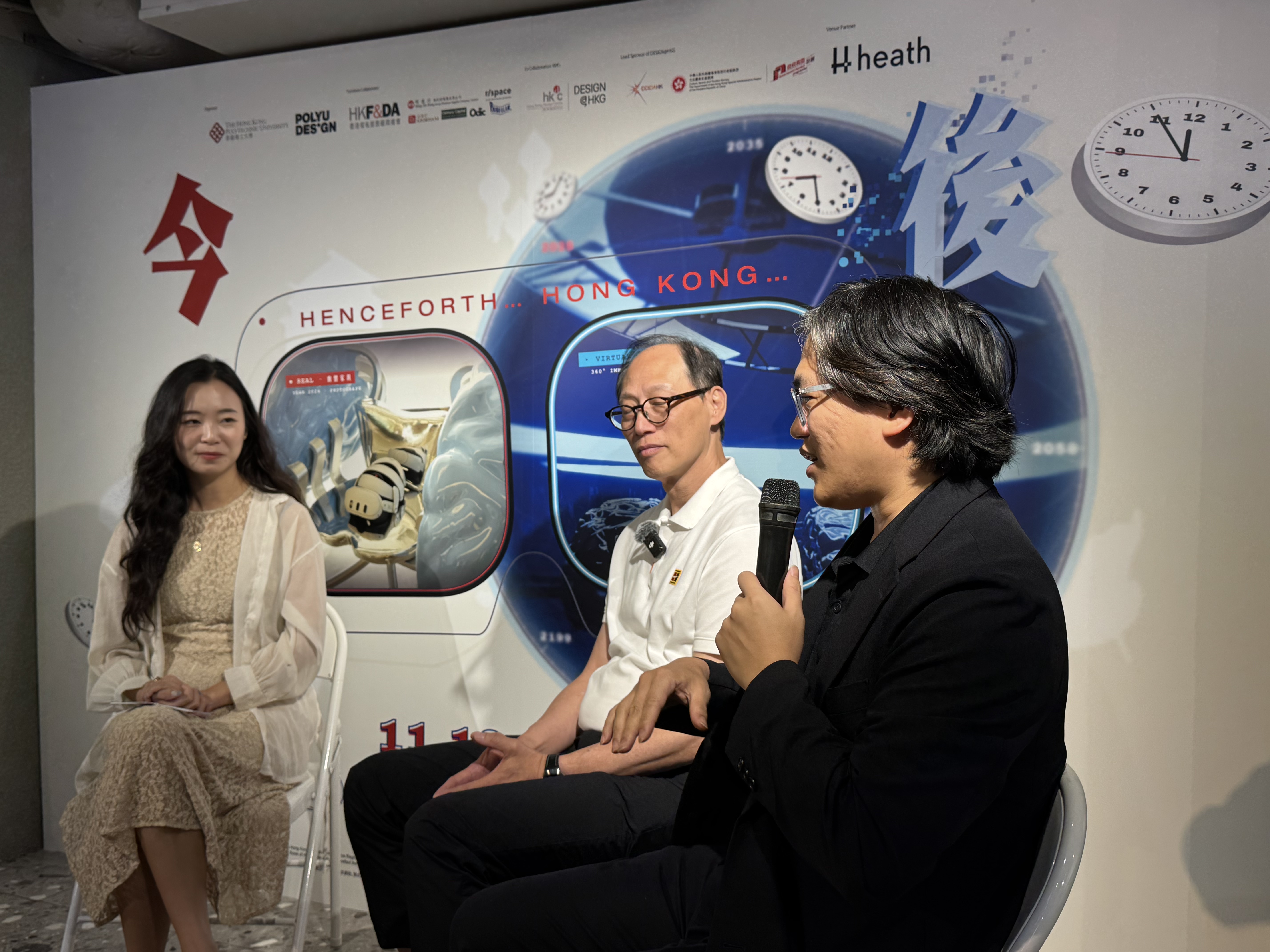
A visitor sat down on a silver chair with two oversized blue half-brains embedded on both sides, put on a virtual-reality headset, and entered an imagined version of Hong Kong’s future. Beside him, a designer explained the experience.
But while the future unfolded in front of him through the headset, the chair under him was unmistakably real, a thing that had to be made, tested, and strong enough to hold a human body.
The scene happened at “Henceforth… Hong Kong…,” a free exhibition at The Grid in Tsim Sha Tsui showcasing nine furniture pieces created by third-year Environmental Design students at the Hong Kong Polytechnic University (PolyU) in collaboration with the Hong Kong Furniture and Decoration Trade Association. The works imagine future living in Hong Kong under pressures including population density, aging and limited resources. Visitors can sit on and touch the furniture, while some works also include virtual reality (VR) experiences. The challenge was turning these imagined futures into real objects using today’s materials and manufacturing methods.
For Sky Lo, an assistant professor at PolyU School of Design, physical experience is central to the project. Lo said virtual environments often depend heavily on what people can see, but people actually experience space through their whole bodies and senses. He added that furniture offers a practical way to make these ideas physical without building an entire imagined city.
But making these ideas physical was not easy.
Theopolis, a lighting installation inspired by an imagined underwater city, had to be made five times before it worked, according to Allen Kwong, chairman of the Hong Kong Furniture and Decoration Trade Association.
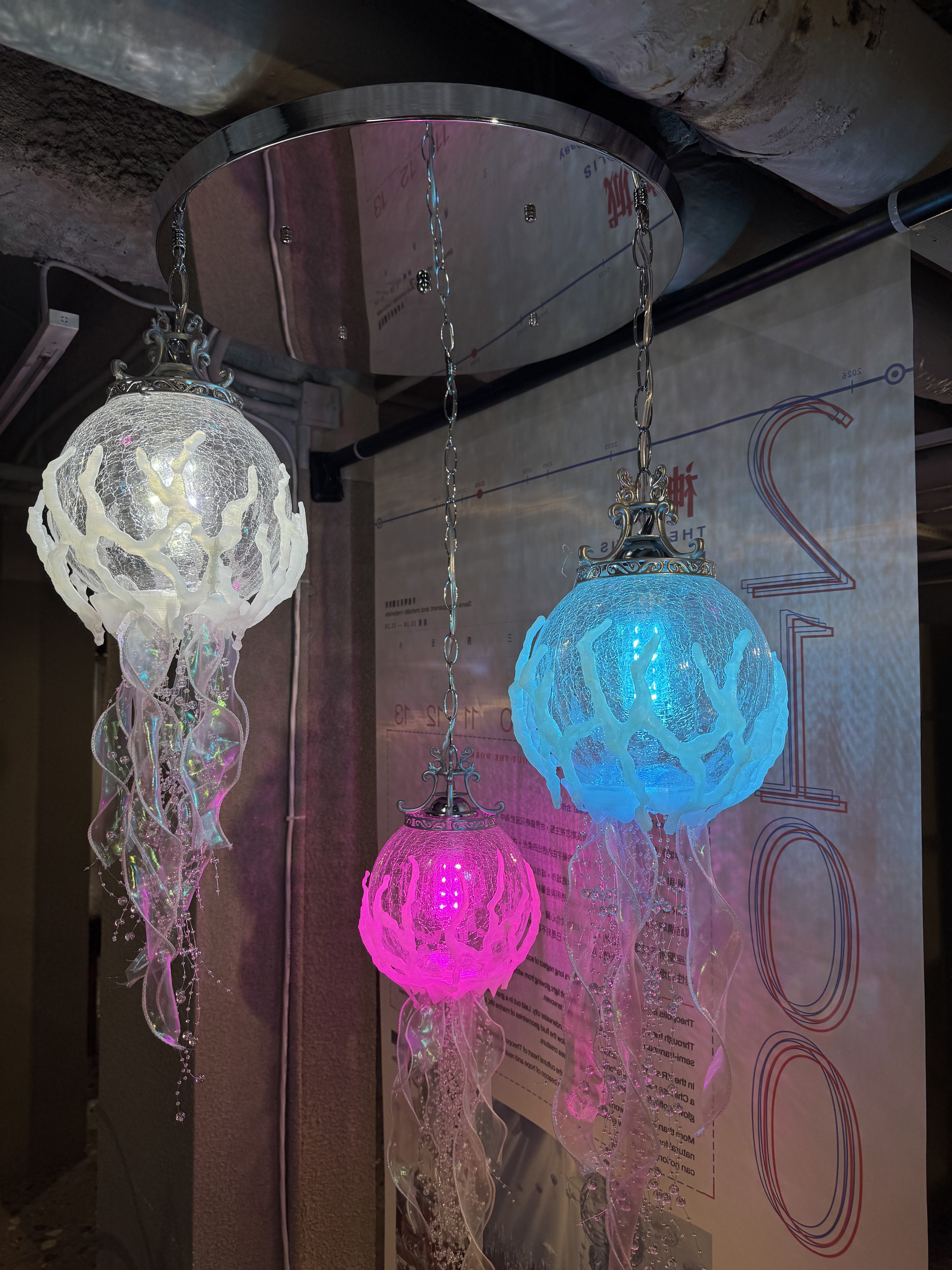
Wong Ka Lok, the exhibition’s design manager, explained that its curved and irregular structure was difficult to produce as originally designed. The team switched to 3D printing, but printing the whole structure in one piece made it easy to break. They then divided it into several parts, printed them separately, and joined them together. Some parts still did not fit completely, so the team eventually used wire to fix them.
Kwong said manufacturers did not want students to change their ideas too much just to make production easier. Otherwise, the final product would become the “manufacturers’ design rather than the students”. He noted their role was to find ways to realize students’ ideas while keeping the original design as much as possible.
The labels beside the works may read 2100, 2130 or 2500. But before any imagined future can reach the exhibition floor, it still has to answer a present-day question: Can it actually be built?