

Eason Chan will re-record his iconic works at the Hong Kong Academy of Performing Arts stage, turning the stage into a live studio for 26 nights with a prohibition on phones and applause.

Eason Chan, a famous Hong Kong singer, announced a bold new project that replaces the usual concert arena with a live stage recording studio, inviting the audience to watch and listen to his iconic works that re-records his 30-year career. Advertised as “McDonald’s Presents: Recording Sessions with Mr. Eason Chan,” the recording series will be held from Dec. 12, 2026 to Feb. 20, 2027, at the Opera House of the Hong Kong Academy of Performing Arts. Ticket prices are HK$980 and HK$1280, with approximately 26,000 seats available primarily through the public lottery by Cityline.
Project details

Different from the traditional concert format, the production put the focus on the intimacy and discipline of studio recording in front of the live audience. Chan will revisit iconic works from his three decade career, with each night’s performance focusing on different albums and no repeated setlist. Completed recordings will later be compiled into a new album.
Since every date is a formal recording session, the attendees must observe studio-level etiquette. All mobile phones must be turned off and sealed in a pouch provided when entering. Media such as photos, audio captures, and filming are strictly prohibited. The audience must remain silent during the recording and may only applaud at certain moments under staff instructions. The final admission time is 8 p.m., latecomers will only be seated at the specified interval. Each performance lasts about 100 minutes, including a 15-minute interval.
University student Cheung Tsz Wa, who has been listening to Chan since primary school, said these rules are acceptable. “It’s just like going to an orchestra concert. I can understand that the host (Chan) wanted the audience to enjoy music without any interference,” he said.
Ballot system draws nearly 5 million registrations

In order to promote fairness and reach the actual target audience, tickets are allocated through a registration ballot on Cityline. Online registration started from 11:00 a.m. on Oct. 28 to 11:59 p.m. on Oct. 29. Registrants had to provide an English full name that matches the identity document, a valid email address, and a mobile phone number that can receive verification text messages. The results of the first round were released on Nov. 2, the purchase window opened on Nov. 5. The second round starts on Nov. 6, with the purchase window opening on Nov. 9.
Nearly 5 million people have registered. Organizers said they would screen duplicate and suspicious entries and accounts, and about 90 percent of the tickets were reserved for the public ballot.
Hong Kong’s current ticketing system
Hong Kong’s main ticketing system has long been struggling for fairness. The most common ticketing method remains the first-come, first-served basis through online platforms, which usually favour buyers with faster internet connections, multiple devices, or scalpers with numerous automatic bots. Meanwhile, a large number of tickets for popular shows are usually reserved for sponsors or media distribution internally, resulting in a smaller public pool and tickets for the secondary market.

Some organizers tried alternatives to tackle such issues. The YouTube channel Trial and Error tried to use the Dutch auction with reduced prices in both its first anniversary show and the later Platinum Awards event. Prices started at HK$ 10,000 and dropped every 24 hours, with a final reserve price of HK$10. It forced buyers to decide how much they were willing to pay and reduced the profit available to scalpers.
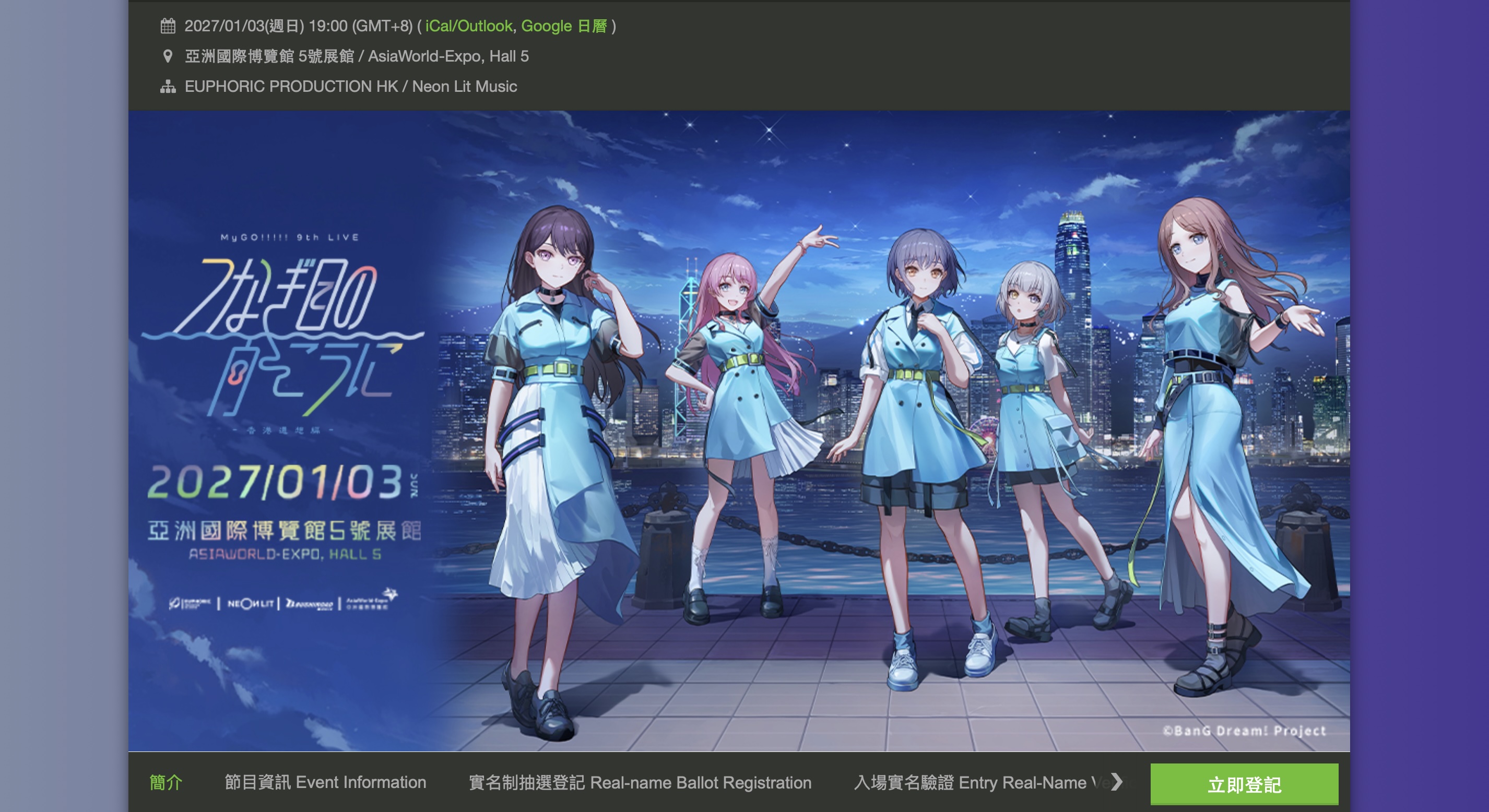
Apart from local organizers, overseas groups also introduce different ticketing methods they use domestically when holding shows. A recent example is the “9th LIVE “つなぎ目の向こうに” – Hong Kong edition concert” by Japanese girl brand MyGO!!!!! scheduled on Jan. 3, 2027, at AsiaWorld-Expo Hall 5. The registration ballot began on Nov. 4. Under the real-name registration system, each person may only register once and apply for a maximum of two tickets. Applicants must submit their official ID name and number for ballot, identity verification is also required by the organizer at entry.
Chan’s pure ballot system sits between these methods. It removes the first-come-first-served speed advantage and opens a high proportion of seats to the public, but it still lacks strong identity verification. Cheung argued that without stricter identity checks, scalpers can still register a large number of accounts and improve their odds. Another university fan of Chan, Wai Ming Tsun, described the arrangement as “falling between two stools,” saying that only the real-name registration system used by South Korea or Japan would be more effective in limiting scalpers, though she welcomed the higher public allocation this time.
What fairness means now
The nearly 5 million registrations reveal Hong Kong’s continued high demand for tickets. For ordinary fans, particularly students with limited resources and time, the issue is no longer remains who clicks the fastest, but which ticketing method best treats genuine fans fairly when demand exceeds supply tremendously.