

Monday (10th of November), Hong Kong’s men’s handball team lost to Beijing in the bronze-medal match at Kai Tak Sports Arena in West Kowloon, finishing in fourth place — their franchise-best result at the National Games under the witness of local crowds .
Following the team’s stunning and surprising upset over Guangdong on last Friday (7th of November), tickets for the remaining handball matches were quickly sold out.
Cheung, a spectator, said: “I bought the tickets for Monday’s game right after watching Friday’s match on TV. I wanted to come with my son and support the team in person.”
Local fans, clad in red to represent Hong Kong, filled the stands and cheered passionately throughout the game. Hong Kong took an early lead, but Beijing gradually turned the tide, pulling ahead 15–11 by halftime. Early in the second half, Hong Kong again struck first, yet Beijing capitalized on transition opportunities to extend the margin to double digits.
Team Hong Kong took an early lead against Beijing with aggressive offense, and every goal was met with thunderous applause from the crowd. Video by Jenny Han on 10th November 2025.
The Hong Kong side continued to press hard to narrow the gap, with goalkeeper No. 8 WONG Ling Chung giving out numerous outstanding saves to bring the deficit back to six points.
However, Beijing eventually sealed the win, defeating Hong Kong 33:25 — leaving the home team just one step short of the podium.

But for a lot of local supporters, this match was about more than winning or losing, but more as a part of a broader emotional experience — which local residents express and reaffirm their sense of identity through sports events and a shared name: “Team Hong Kong”.
On the 14th of last month, a record 45,489 fans attended the Asian Cup qualifying match between Hong Kong and Bangladesh at the Kai Tak Stadium, setting a new attendance record for local football fixtures. It is possible for the number to be surpassed when Hong Kong takes on Singapore on the 18th of this month, which has sold out within 90 minutes.
Unlike football, however, handball remains a niche sport in both Hong Kong and globally.
Moreover, right before the lead-up to the National Games, reports revealed that each player of the Hong Kong Handball team would only receive about HK$4,000 per month in government stipend — which payments that had not yet been disbursed this year. Of the team’s 16 players, 15 either quit or took unpaid leave from full-time jobs to focus on the preparation of the National Games.
While their opponents — well-funded provincial teams from mainland China — enjoy far superior resources, facilities, and training time. By comparison, Hong Kong’s squad is an underdog.
Yet this very underdog team stunned Guangdong and had an epic fight with Beijing, setting a historic benchmark for Hong Kong handball and igniting an unexpected level of local enthusiasm.
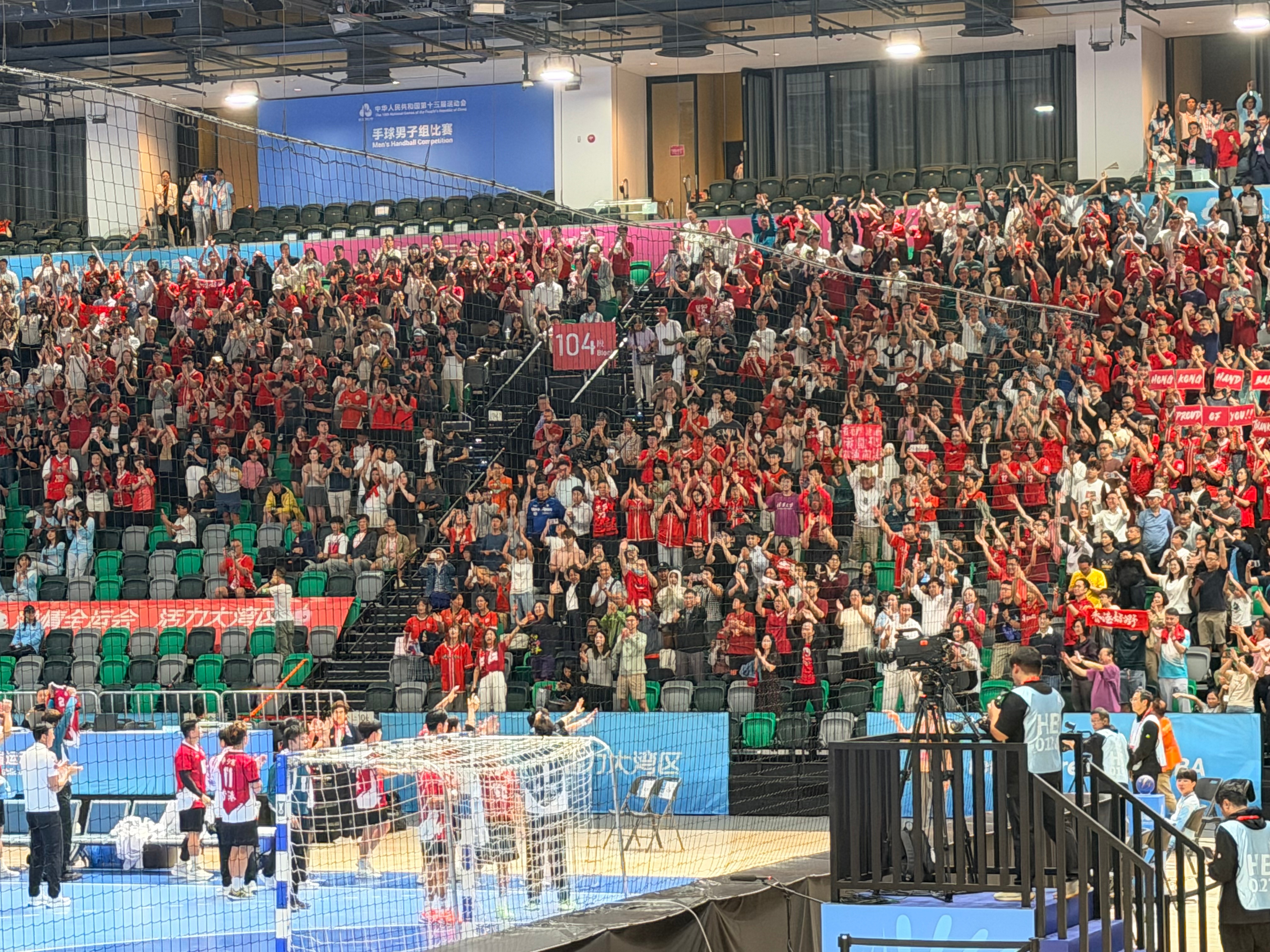
In today’s Hong Kong, the meaning of sports seems to have gone beyond competition alone — becoming something more socially and emotionally significant.
By wearing the same red shirts, chanting the same slogans, and sharing the same moments of excitement or disappointment, local audiences turn the arena into a collective space — sports, in this sense, serve as both a stage and a medium through which a community can make its shared identity visible.
This also explains why many Hongkongers show up in full support of “Team Hong Kong,” regardless of the sport’s popularity, the team’s resources, or the odds of victory.

As long as the name “Hong Kong” appears on the scoreboard, the crowd’s cheers follow. For some, sports have become an outlet for identity affirmation — a way to strengthen and reconnect with what it means to belong to this city.