

A trip to the Immigration Tower turned into an unexpected history lesson for Marie Sheets on Oct. 2, when she stopped to look at an exhibition board in the building’s lobby.
“I was going to get my HKID, and I stumbled upon this lovely exhibition,” said Sheets, a UK student spending a year on exchange in Hong Kong. “I thought it was really insightful that they made education about these sites so accessible by having them in a public place.”
The exhibition is a part of the Heritage Fiesta 2026, organised by the Commissioner for Heritage’s Office of the Development Bureau. The three-month-long programme runs from October to December, organised under the theme “Traversing Northern Metropolis”. It spotlights 12 selected sites with declared monuments and graded historic buildings in Hong Kong’s Northern Metropolis, including ancestral halls, heritage trails and former schools.
The project will also feature free guided tours of the participating places running from November to December, alongside public talks, parent-child workshops and a new open-top bus heritage tour, according to the Heritage Fiesta Newsletter.
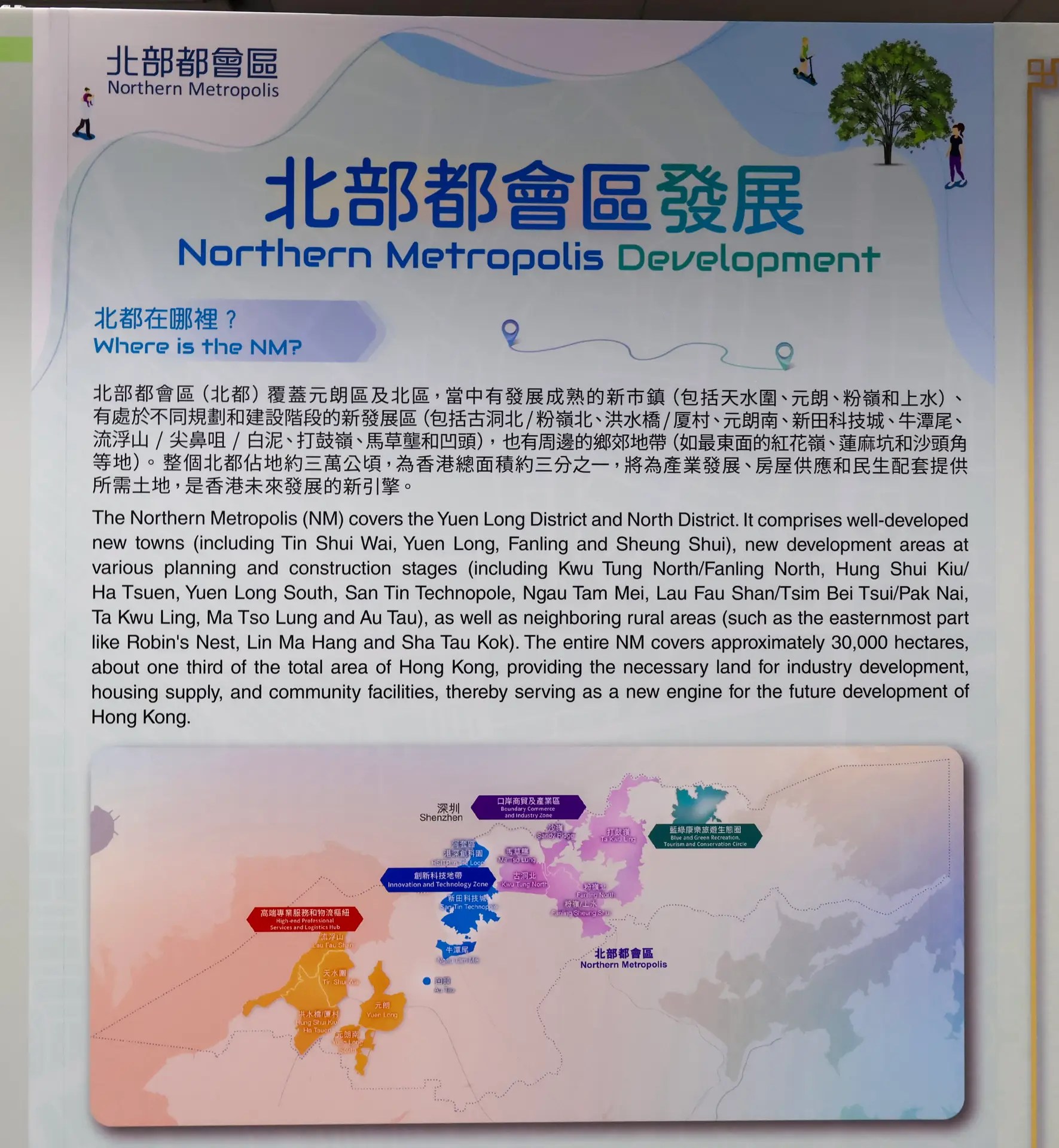
Easy to Stumble Upon
The exhibition opened at the Immigration Tower in Wan Chai and the Civic Education Resource Centre (CERC) in Chai Wan on Oct. 2. The two displays will remain open until Dec. 31, with free access from 10 a.m.-7 p.m. and 9 a.m.-6 p.m., respectively. CERC is also hosting an online version of the exhibition during the same period. As government-designated venues, the two locations provide information about Northern Metropolis heritage in urban areas where people may access it without travelling to the northern New Territories.
In Wan Chai, the exhibition occupies a section of the first-floor lobby. Placed along the route towards the Hong Kong Convention Centre, it remains visible for people visiting the building for other reasons. The display itself is relatively small, consisting mostly of long information boards with photographs and text about the featured historic sites. However, despite its size, a mid-afternoon visit showed that several people stopped to look at it. Some elderly people took out their phones to scan QR codes, while others read the information panels or picked up brochures.

The display also encouraged passersby to engage with the broader Heritage Fiesta programme. Questionnaires asked visitors about the event and what might convince them to participate in similar activities or events. At the same time, QR codes linked visitors to HK Heritage Live’s Instagram and Facebook pages, as well as to more information about the event on the official website.
For Sheets, the chance discovery made the exhibition worth her time despite its size. She said she liked the photographs, the informative text and the brochures. She said, “I like history, so I saw something that said history and heritage, and I immediately went, ‘Oh, I want to look at that!’”

Sheets also mentioned she would be less likely to visit the actual historic sites because many are far away and take time to reach. But learning that these places existed gave her a reason to consider them.
Reaching Different Audiences
At the CERC in Chai Wan, the exhibition takes a separate approach. Located on the seventh floor of the Youth Square, it occupies a large gallery with pop-up standees, stamp-collection materials, and information panels.

However, the gallery remained quiet at 5 p.m. on the exhibition’s opening day. Winny Wenying, a staff member at CERC, estimated that around 10-13 people visited that day. She said that it was still the first day and hoped more people would come in the following days.
The two venues offered different ways for people to encounter the exhibition. In Wan Chai, visitors unaware of the display stumbled upon it while being there for other reasons. In Chai Wan, people had to visit the Youth Square and then make their way to the seventh-floor gallery to find it. These two venues illustrate the challenge of bringing heritage to an audience that may not already be seeking it.
These venues are only two stops in the exhibition’s route. The exhibition includes 18 locations in total, and will move between other public venues over the next few months. It will be displayed at Yuen Long Plaza from Oct. 7 to 14 and Times Square in Causeway Bay from Oct. 16 to 29 before moving to different public libraries. The various locations allow the exhibition to reach people who may not seek out this information themselves.
Heritage Amid Development
The question of how people outside the Northern Metropolis view the area is becoming more significant. The Government describes the Northern Metropolis as a major focus of Hong Kong’s future development. Its latest plans include university towns in San Tin, Hung Shui Kiu and Ta Kwu Ling as well as other technological and infrastructural projects, according to the 2026 Policy Address.
For Meruyert Ainadin, a third-year architecture student, the changes in the Northern Metropolis raise concerns about how the area’s heritage can be conserved alongside development. Her studio project this year focuses on ways to preserve the heritage in the San Tin area. She believes that heritage concerns extend beyond historic buildings to traditional village activities such as fishing and shrimp production, and to natural habitats like the wetlands around them, as they are also part of a place’s character.
“I think it is really important to save or reconstruct as much as we can to keep the history,” she said.
Ainadin also believes that people living in more urban areas of Hong Kong should be aware of the rich history of the territory’s northern parts. “Some parts of Hong Kong can be overlooked by others, but of course they [Hong Kongers] have to know their history and their heritage,” she said. “If they will not preserve their own history, nobody else will do it for them.”
Her comments come as the Government’s current plans seek a ‘co-existence of development and conservation.’ For Ainadin, preserving the Northern Metropolis means ensuring that the history of these places remains known beyond their creation, alongside the changes taking place there.
Back in Wan Chai, that history reached Sheets by chance. The exhibition introduced her to parts of Hong Kong she had not known about before.

“I would have no idea about any of these things if I hadn’t stumbled across that exhibition,” Sheets said. “So I’m really grateful to have found it.”