

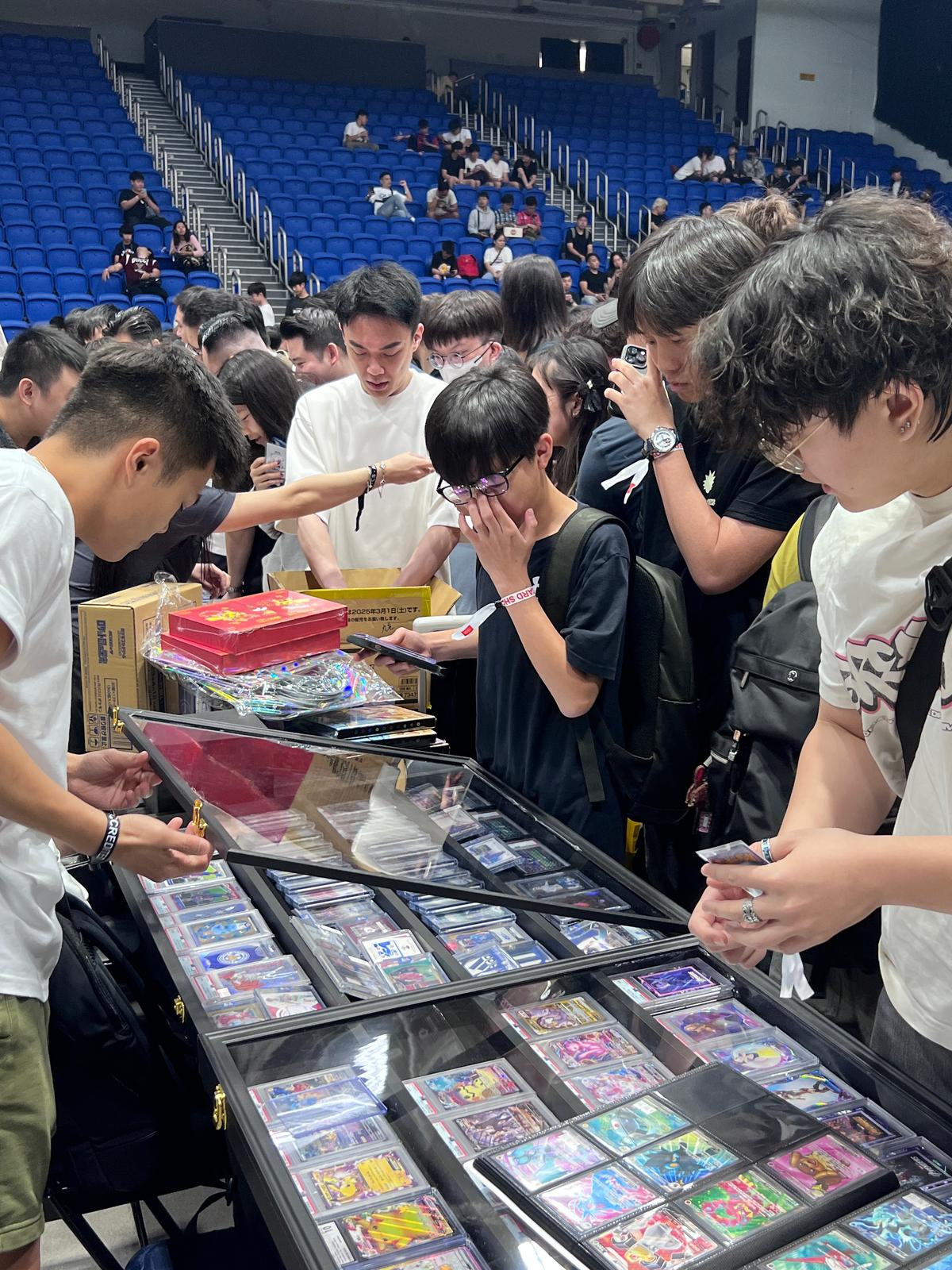
“I just came by because it was the weekend and I had nothing to do. But somehow I ended up buying two boxes,” laughed a 26-year-old Jason Lau as he squeezed through the crowd at Southorn Stadium in Wan Chai, clutching two freshly purchased boxes of Japanese Pokémon cards. Behind him was the bustling venue of the 2025 Hong Kong Trading Card Show.
The atmosphere was electric. Booths were surrounded by players and collectors alike, some flipping through binders to hunt for specific cards, others sealing deals on the spot after card grading sessions. According to initial estimates from the organizers, the total transaction volume at the event was expected to exceed six figures in Hong Kong dollars, far beyond their original expectations for what was intended to be a niche community gathering.

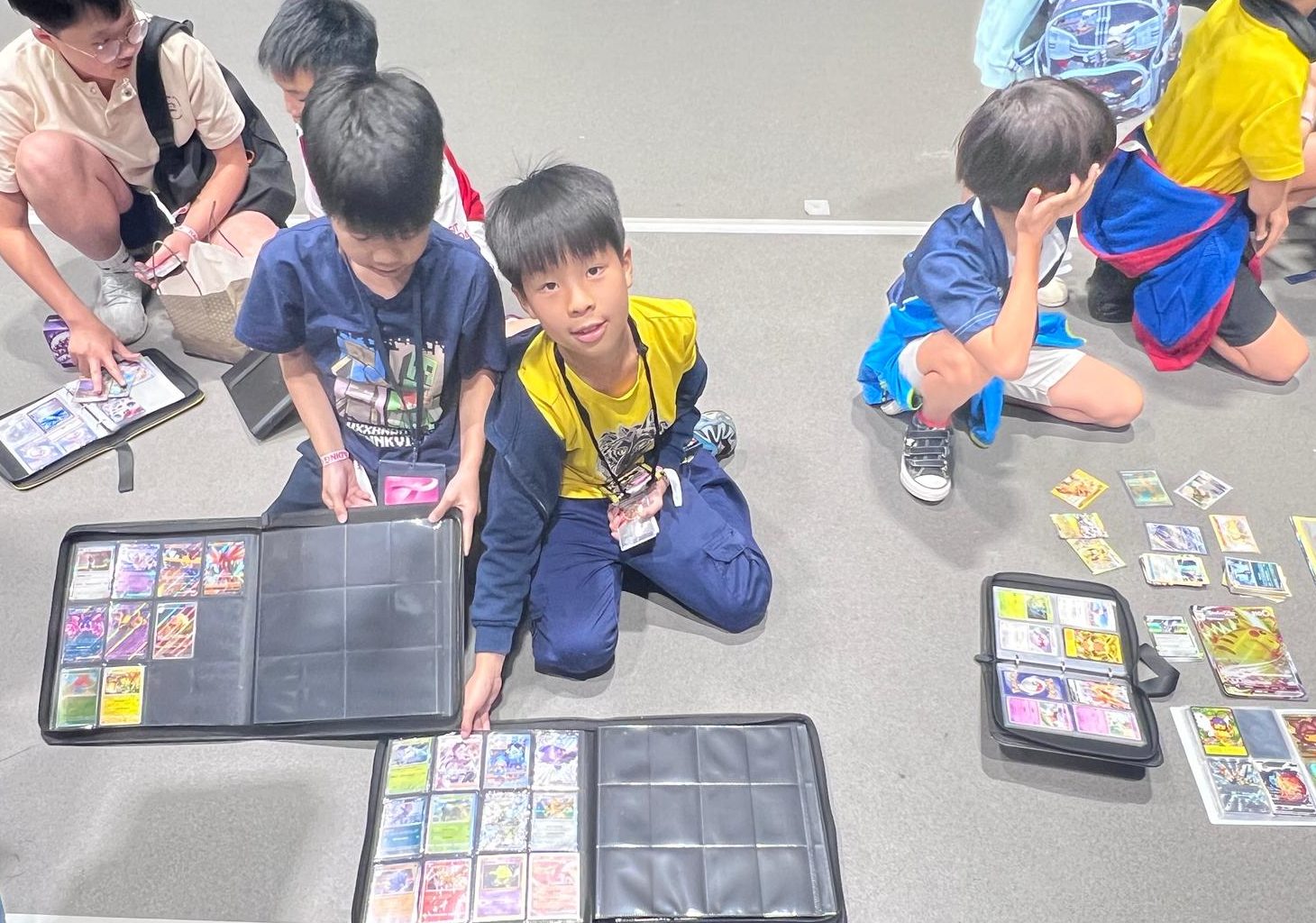
“We honestly didn’t expect such a big turnout, and quite a few young kids were attending with their parents,” said Adam Brough, one of the event’s co-organizers.

The Pokémon franchise, originally launched in Japan in 1996 by Nintendo, Game Freak, and Creatures Inc., quickly grew into a global phenomenon. The Pokémon Trading Card Game (TCG) debuted the same year in Japan and began expanding internationally in 1999. Initially conceived as a spin-off product to accompany the video games, the TCG rapidly gained traction among teenagers. Its core mechanic remains simple yet unpredictable: players purchase randomized booster packs and use the cards drawn for gameplay, collection, or trade.
Over the years, Pokémon has grown far beyond its original form. In addition to video games and trading cards, the franchise includes plush toys, apparel, and a vast array of merchandise. In 2016, The Pokémon Company revolutionized mobile gaming with the release of Pokémon GO, blending augmented reality with real-world exploration. More recently, the launch of Pokémon TCG Pocket has merged two of the company’s strongest pillars — card collecting and digital gaming — into one mobile experience.
Today, local card stores in neighborhoods like Mong Kok and Sham Shui Po are packed every weekend. Online, the scene is just as active: from Telegram trading groups to Instagram reels and YouTube livestreams, Pokémon cards have become far more than toys. They are emotional anchors, social tokens, identity markers — and for some, even financial instruments.
What Is Happening?
The Pokémon Trading Card Game has always retained a loyal mass of fans that will consistently show up for new releases and cool cards. However, there has been a significant shift in the volume of attention that the mainstream public is now showing to the community. Roy Kiu, the 26-year-old owner of Blazing Dragon Cards and Toys, located in San Po Kong, attributed this massive rise in popularity to a few key factors. A slew of bad sets early in the year, leading into a massive release and the release of the mobile game Pokémon TCG Pocket.

Kiu described the first nine months of 2024 as nearly fatal to his business. Due to the Pokémon and themes of these sets, prices of cards and sealed products alike sank, and when prices go down, sellers begin wanting to get rid of their cards before their price drops even further. He said that some weeks he would go four to five days without even seeing a customer in his store.

However, that quickly changed when Pokémon TCG Pocket came out in late October. With over 60 million downloads, the game has become somewhat of a global phenomenon. The game is the first Pokémon game to focus on the collection of Pokémon cards, giving players two free packs to open every day.
“I was always a fan of Pokémon, but after playing the game, it kind of made me want to open some real packs,” casual fan Andrea Yuen said. “I had seen some YouTubers opening cards, and they looked really cool.”

Then, during early December, the Japanese set Terastal Festival dropped, which saw massive demand. Normally, Japanese boxes of Pokémon cards sell for 5400 yen retail (around 300 HKD), but on release, it sold for, and continues to demand a market price of some 700-800 dollars, almost 2.5 times MSRP. A similar situation occurred in Europe and the United States when Primastic Evolutions (the English version) was released. The demand was so high, people began lining up outside of local game stores, Walmarts, and Targets before the sun even rose, just for a chance at some Pokémon product.

A major reason for the popularity of this set is due to the chase cards of the set being some of the most beloved Pokémon the franchise has seen, the “Eeveelutions,” which are different evolutions of the iconic and cute Pokémon Eevee. Many collectors were also drawn to this set because of the beautiful art depicting those “Eeveelutions”. Kiu observed that this set was much more popular amongst women and girls, who normally are not massive participants in the Pokémon card market. It meant that the cards were reaching a mainstream appeal because of the quality of the product that the Pokémon company had released. But most importantly, the art made for the chase cards was simply beautiful; the attractiveness of the card often is the biggest factor in driving popularity and thus price.

What Factors Are Driving?
Emotional Drivers
Pokémon is far from new, but people’s enthusiasm for it has never disappeared. Its popular IP, rich and diverse interactive methods, and the release of many digital games in recent years have also attracted more and more people of different generations. For many millennials and Gen Z collectors, Pokémon cards vividly evoke memories of playing Game Boy games and trading cards during their school days.
“I played Pokémon games in my childhood, and I started collecting cards in 2015,” said James Wilson, who comes from the UK and works in HK. “I got back into the hobby mainly because of that nostalgia, and the art on the cards is just really nice.”

Beyond nostalgia, card collecting has become a powerful social identity construction. Owning rare, high-grade cards is increasingly perceived as a subtle indicator of taste, commitment, and insider status, much like wearing a pair of limited-edition sneakers.
This aligns with Maslow’s hierarchy of needs,” explained Dr. Julian Pfrombeck, Assistant Professor of Psychology at the Chinese University of Hong Kong. “After satisfying basic physiological and safety needs, many individuals today are operating at the level of social belonging and esteem needs. Some have even moved toward pursuing self-actualization, and collecting culturally significant items like Pokémon cards satisfies these higher-level psychological motivations.”
In tightly-knit communities, rare cards are not merely material possessions but social capital, offering both prestige and a tangible sense of personal achievement.
Investment Appeal

Financial speculation has also played a critical role in fueling the Pokémon craze. Certain limited-edition Japanese cards have doubled in value within just one year, with rare editions selling for up to HK$400,000 or even more. According to statistics from The Trade Spotter, as of March 2023, the most expensive recorded sale of a Pokémon card was the 1998 Illustrator CoroCoro Comics Promo (Pikachu Illustrator Card), which set a Guinness World Record after being sold to Logan Paul for $5.275 million (USD) in 2022.
Often, before a set release, the prices of cards related to the theme of the set will see a spike in their market price. Usually, even if the cards meet the expectations of collectors and players, the market will still undergo some correction as prices easily get out of hand. Despite overhyping and corrections of the market, when looking at price trends over time for most cards and products, it will continue to trend upwards. Similar to the stock market, the Pokémon card market also experiences peaks and valleys, but Pokémon cards are not as regulated and can be affected by more trivial things.
The way I see it, each of us in the community are a tooth on the cog that allows the market to reach these heights” said Kiu, “as we buy cards, its price is only reaffirmed and allowed to keep rising, which makes people pay more attention and lead to more people buying those cards.”
This cyclical phenomenon he describes often leads to people buying cards simply because of their price and not because they genuinely want the card or like the art on it.
Hong Kong’s long-standing financial culture, combined with a post-pandemic surge in interest in alternative assets such as sneakers, collectibles, and figurines, has made trading cards an increasingly attractive option for asset diversification and short-term profit.
Simultaneously, a wave of prominent Internet influencers entering the space has helped dissolve the “geek culture” stereotype, turning card collecting into a mainstream fashion statement. Some influencers now even provide “investment tips” and “market updates”, forming a fully-fledged Pokémon card investment ecosystem.
Social Dynamics
Beyond collecting and reselling, Pokémon cards have evolved into a vibrant social medium that bridges online and offline worlds.
In districts like Kwun Tong and Sham Shui Po, card shops frequently host live pack openings, tournaments, and community gatherings, making them weekend hotspots for enthusiasts. These stores offer not only card sales but also gameplay tutorials and advice for beginners.
The online sphere is even more dynamic. Platforms like YouTube and Instagram have built a complete content-and-commerce ecosystem around Pokémon cards. Pack opening streams have become public spectacles, where each rare pull generates massive emotional resonance among viewers. In 2021, Typical Gamer, a YouTuber with over 15.7 million subscribers, held a three-hour live stream opening 300 Pokémon card packs, and the video has since amassed over 11 million views.
“The thrill comes from the uncertainty — it’s raw, it’s live, and it feels real,” explained Marcus Tong, a collector for five years.
On Instagram, posting rare pulls and recent acquisitions has become a social trend. “This can be a textbook case of FOMO (Fear Of Missing Out) dynamics,” noted Dr. Pfrombeck, “Seeing others obtain rare cards triggers anxiety about missing out, which accelerates market participation.”
Issues And Controversies
While the craze for Pokémon cards remains strong, where there is heat, there is hype, which in turn drives the heat up a notch. On many online platforms, fake cards are spreading. Some imitations are so convincing that even experienced collectors have been fooled. “I paid HK$1,500 for a card, thinking it was exclusive to Japan,” said Sam Chueng, who has been collecting cards since 2018. “Then I realized I was being ripped off when I realized something was wrong with the holographic foil.”
More worryingly, the randomness of the industry is a strong draw for children. The thrill of opening a “booster pack” (a sealed set with unpredictable contents) is very similar to the mechanics of gambling. Some parents worry that their children will become addicted not only to the cards but also to the dopamine rush that comes with the unknown. “I’ve seen kids spend their entire week’s allowance hoping to get a rare card,” Kiu said, “and if they don’t, they beg their parents to buy more.”
Experts have expressed similar concerns. “Pack opening culture exploits an intermittent reward cycle,” Dr. Pfrombeck explains. “That’s particularly harmful to the developing brain.”
In addition, the market for Pokémon cards remains unregulated, and consumers’ rights are easily violated. There are now cases where influencers with large followings hype certain card sets or cards, and then sell them off after the price soars. “You might see someone hyping a card that they secretly own hundreds of,” said Jessica Lam, a part-time card dealer who posts market updates on Instagram.
As the line between hobbies and commercial activities becomes increasingly blurred, many people are calling for clearer regulations and stronger consumer protections, especially for young players who are just entering the field.
Next?
Amid soaring prices, a critical question emerges: Is the Pokémon card market undergoing genuine value discovery, or is it inflating into a speculative bubble?
“As we often say, ‘rarity creates value.’ Pokémon cards naturally fit this principle,” said Kennis Lee, one of the staff members of this trading card show, who is also a card collector and reseller.
However, as a typical “interest asset,” the prices of trading cards are unlikely to remain detached from their tangible appeal and actual market demand indefinitely. If liquidity tightens or public interest wanes, non-core rare cards could be the first to see significant price corrections.

However, regardless of market fluctuations, this phenomenon reveals a deeper transformation in Hong Kong’s cultural consumption landscape. More young people are willing to pay for “emotional value” — investing time, money, and identity into communities and expressions of belonging. Compared to traditional rational consumption models, today’s environment resembles a “participation economy,” often marked by impulsiveness and social contagion.
During interviews, some participants framed their purchases as “rational allocation,” while others admitted they were simply “playing for fun.” Yet the majority confessed that profits were not their primary motivation, but they wanted to participate, to be seen, and to belong.
“Whether the card is expensive or not doesn’t matter that much. I just started collecting because I really liked the cards,” said Preston Lau, a ten-year-old Pokémon card collector who started collecting at the age of three. “I can share them with my friends.”
The set releases in the near future from the Pokémon Company are all fan favourites, from the Black and White set coming up, to the 30th anniversary celebration of Pokémon next year, the hype for Pokémon cards does not seem like it is going away anytime soon. And in the era where consumer goods and cultural capital increasingly intertwine, cross-border and culture-driven assets like Pokémon cards will continue to emerge, evolve, and cycle through waves of popularity.
This may not only be a kind of card revolution, but also a new chapter in how generations express a common identity and build cultural meaning together.
1 comment