

Hong Kong has always been recognized as Asia’s dynamic metropolis and a major player in the global fashion industry, taking a leading role in ecological initiatives.
According to the World Wildlife Fund (WWF), the fashion industry ranks among the most significant sources of pollution worldwide, impacting through energy use, greenhouse gas emissions, water consumption, chemical pollution, and waste production. Annually, 85% of textiles, equating to around 21 billion tonnes, are disposed of in landfills or through incineration. Moreover, the category of clothing filled up to 15% of Hong Kong’s total Ecological Footprint. While Hong Kong’s advances in technology have improved production processes, they still contribute to air pollution challenges. This dilemma has sparked a new perspective in the city—sustainable fashion.

One of the most pressing environmental challenges currently faced in Hong Kong is landfill waste. Each year, approximately 4.17 million tonnes of solid waste end up in the city’s landfills.
Right next to The Mills factory, there is a giant recycling center. This area specifically handles a significant number of garments that can be recycled.

Given Hong Kong’s density, nearly 7.5 million residents are struggling to find space for new landfills. Reducing and recycling are crucial long-term solutions to effectively manage the city’s growing landfill waste. Sustainable fashion has become one of the solutions.
Fast Fashion-H&M with HKRITA Steps in For a Change
As a leading fast fashion brand in Hong Kong and globally, H&M steps towards sustainable fashion by using recycled cotton, polyester, and other recycled materials. Additionally, the need to cooperate with local textile institutions to embrace sustainability and foster a greener future for the fashion industry becomes increasingly critical.
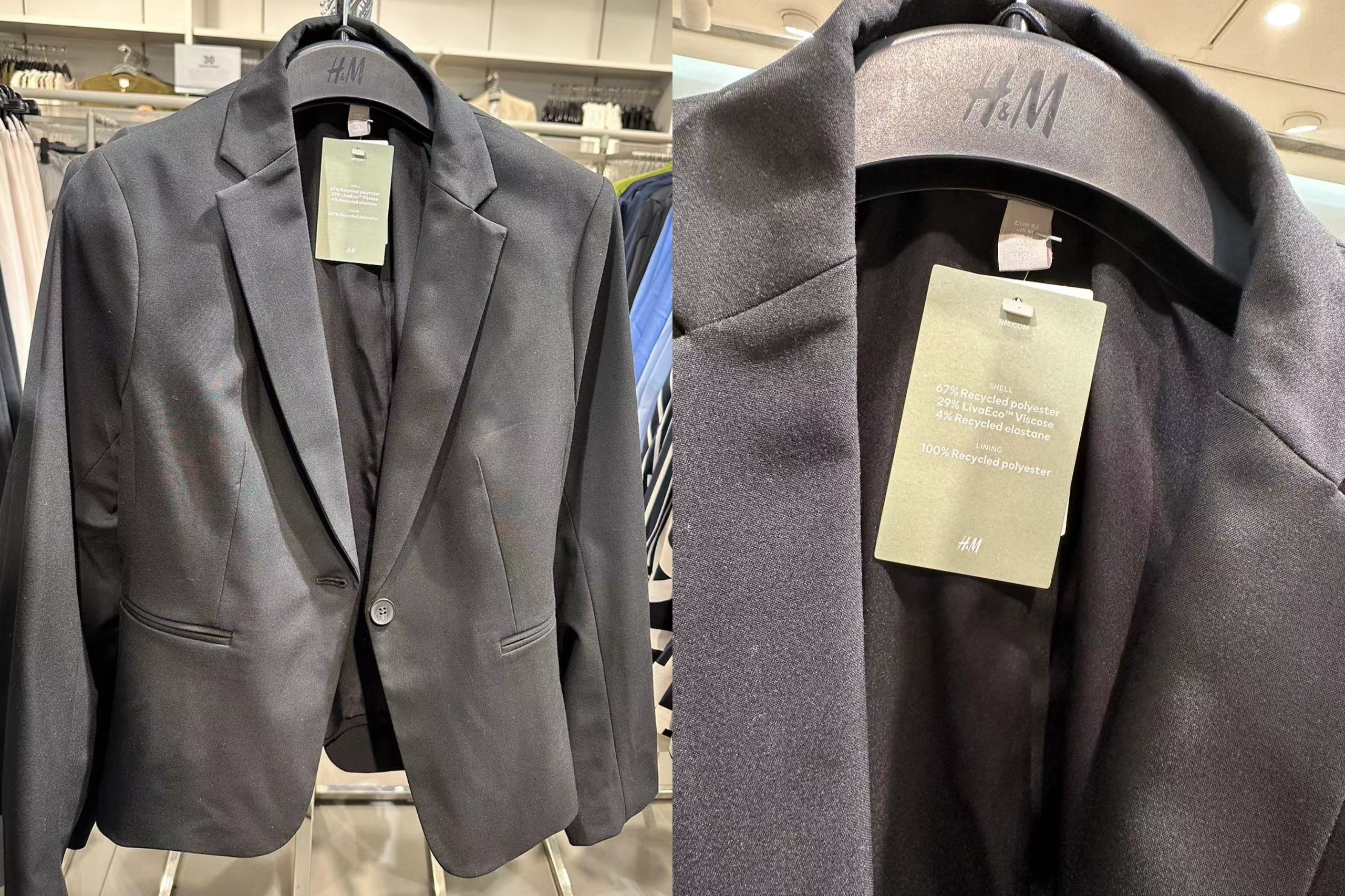
“I often gravitate towards H&M because their clothes are super cheap and most convenient,” said Samantha Shen, an 18-year-old girl shopping in H&M, “Recently I have seen the recyclable materials on the tag too, I think that’s very ahead among other brands.”

The Hong Kong Research Institute of Textiles & Apparel (HKRITA) is a renowned research institute that advances the fashion and textile industry through research, development and technology transfer.
As a former textile manufacturing hub, it has gained recognition for its impactful initiatives, including the Sustainable Circular Coloration Technology for eco-friendly dyeing project. This project aims to facilitate water reuse and recycling in textile dyeing, and decrease the environmental impact of dyeing pollution according to the HKRITA website.

The Green Machine, a polyester and cellulose recycling system jointly developed by HKRITA and H&M, is an innovative recycling technology that effectively separates blended textiles on a large scale using only water, heat, pressure, and a biodegradable chemical. This advanced system employs hydrothermal treatment and dissolution treatment to decompose cotton into cellulose powders, facilitating the separation of polyester fibers from cotton-polyester blends while maintaining the quality of the polyester for fiber-to-fiber recycling. The initiative not only helps reduce textile waste but also promotes the use of recycled materials in the fashion industry.
The Green Machine’s recovery rate exceeds 97% for polyester fibers within two hours, making it a commercially viable solution for blended-textile recycling. This process also converts recycled cotton into valuable cellulosic powder, which can be utilized in applications such as super-absorbent materials for agriculture and the manufacturing of durable water-repellent finishes, thus fulfilling the goal of “end-to-end recycling.” Meaning from the point of consumption back to the production of new materials.

Recently, HKRITA launched a new 20,000-square-foot research and development Open Lab focusing on innovative textile solutions with H&M. One of the lab’s first projects, ‘Farm-to-Garment,’ utilizes hydroponic techniques to significantly reduce water consumption for cotton farming, while the advanced Green Machine 2.0 enhances recycling capabilities by efficiently separating blended materials.
“I look forward to the new policy about the raise on recycling and if they charge the rubbish or bags and try to reduce the consumption,” said Ryan Wong, 42-year-old, business development manager of The Hong Kong Research Institution of Textile and Apparel.