

After retiring from his government role in urban planning, Terence Tung leased a neglected plot of land in Lam Tsuen, Tai Po, spanning roughly 3,000 square feet. From clearing waist-high weeds, setting up workstations to tilling the soil and planting crops, he transformed the overgrown site into a functional community farm, De Horus Tai Po. Introducing the project with a proud smile, Tung described it as the result of his “one-man band” efforts.
The farm’s Chinese name translates to “Science & Arts Experimental Farm.” Calling the farm experimental, Tung is using it to test which crops are best suited for cultivation in Hong Kong’s soil. He added that he is to share his findings with others interested in growing their own farm-to-table produce.
“This is entirely a personal initiative,” Tung said, noting that he funds the project solely with his pension. “The government doesn’t test these things in practice, so they have no idea how difficult it really is.” Tung’s concern is directed at the Agriculture, Fisheries, and Conservation Department (AFCD)’s crop farming provisions in the Blueprint for the Sustainable Development of Agriculture and Fisheries, launched in December 2023.
The Government’s Ambitions
According to the “Blueprint,” the goal for crop farming is to increase annual vegetable production fourfold, from about 15,000 metric tons currently to roughly 60,000 metric tons within 15 years. Urban farms are expected to contribute at least 10% of local vegetable production in the future.
To achieve this target, the AFCD plans to designate Agricultural Priority Areas and Agri-parks, implement urban farming strategies in designated zones, and support the development of leisure farming activities. The “Blueprint” also highlights the use of “environmentally friendly and modernized technologies” in the implementation of those initiatives.
Hong Kong’s commitment to develop sustainable agriculture can be traced back to 2014 when the AFCD launched public consultation on new agricultural policy, as an adjunct to the development of the broader green movement and efforts to enhance cultural identity. At the time, Dr. Ko Wing-man, who served as Secretary for Food and Health, attributed the advantages of sustainable agriculture at a press conference to diversifying the food supply, reducing reliance on imported goods, and improving food safety.
Professor Mathew Pryor, a specialist in ecologically-focused landscape architecture from the University of Hong Kong’s Faculty of Architecture, commented that while the government has been on the right track in supporting urban farming, it seems to rely on unsuitable methods to evaluate its outcomes.
“Unfortunately, a decade passed but the government is still arguing for agriculture on the basis of food security and food supply and food health safety, not understanding that this [urban farming] can never be commercial,” said Pryor. “My argument is you [urban farmers] are producing happiness most of the time, which is an even more valuable thing to produce. It’s about social and environmental well-being, rather than food. Hong Kong consumes so much food. Of course, the food that we produce is not food that we want to eat anyway,” he added.
According to data from the AFCD, only 1.9% of the fresh vegetables consumed in Hong Kong—equivalent to 14,800 tonnes—are produced locally. For fresh fruits, the figure is even lower, at just 0.13% of consumption.
The Happiness
Jacob Lee has managed the remnant New Zealand Organic Farm for more than a decade, using his own savings to keep it running. The farm operates on a multifunctional model: one section of the land is rented to visitors for hands-on farming experiences, another is used for fruit and vegetable production, and an open, unplanted area is reserved for activities such as team-building events.
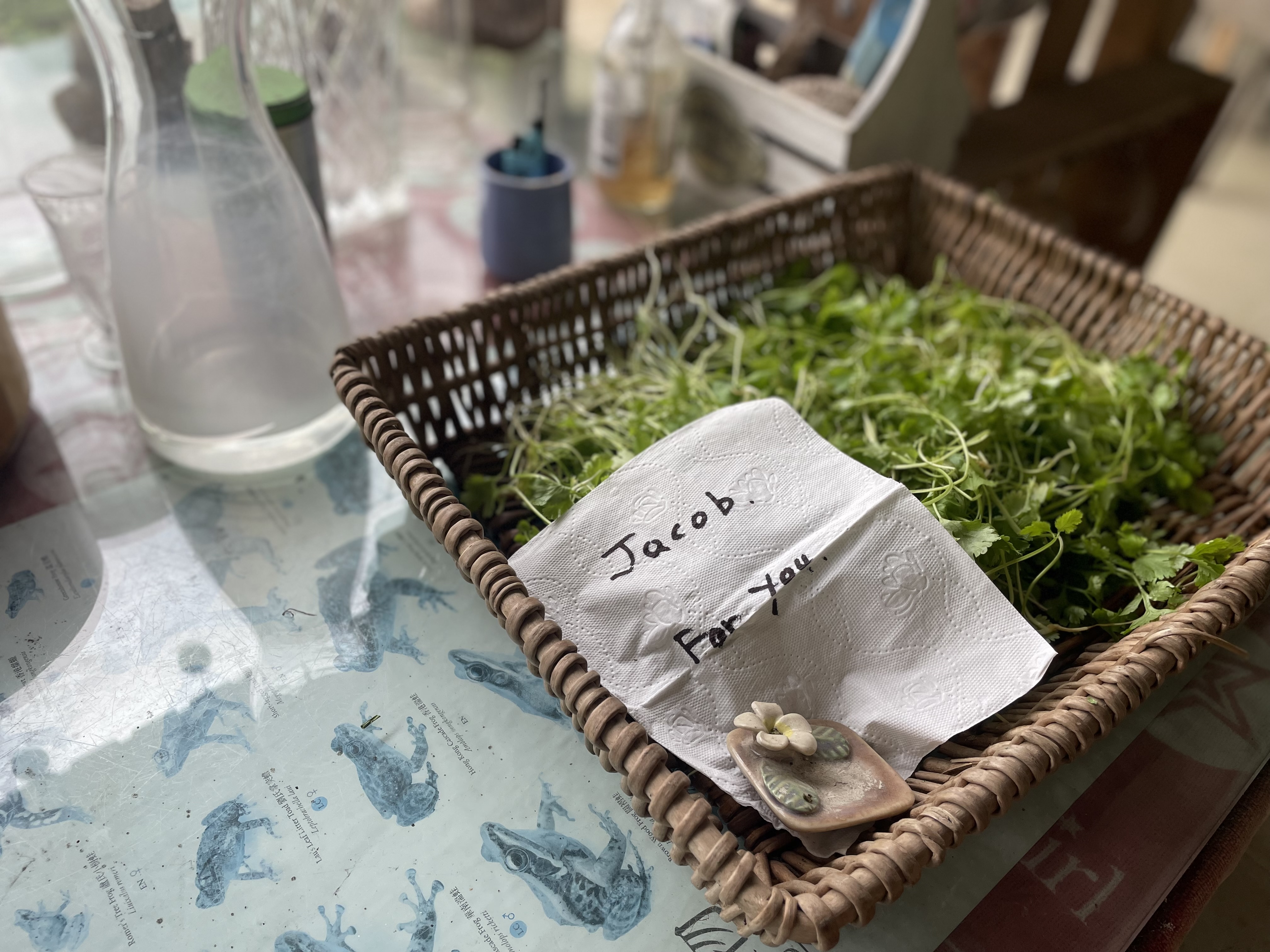
The farm’s income comes from rental fees, delivery charges for produce, and profits from produce sales, with profits from each source roughly equal. Only in very recent years has it reached a break-even point, with revenues fluctuating based on weather conditions and current events. When asked why he has committed to farming for so long, Jacob said it’s about finding inner peace. “Of course, I expect to earn money from it because I need to live. But it’s not all about money. It’s the only thing I love,” Lee said.
Lee dedicated his university years and early career to environmental protection, including a role in Environmental Protection initiatives at the Swire Group. “But I kind of agree that when I’m at Swire, I’m Swire. When I’m really here farming and touching the soil, I’m myself. I feel the sense of achievement,” he added.
On Lee’s farm, a quaint shed stands with shelves meticulously arranged, each lined with toolboxes. Every toolbox bears a name tag, not of people, but of plants—“Mint,” “Lemon,” “Tomato,” and more. Jacob explained that the weekend farmers here adopt plant nicknames as their own, and the shed serves as a home for their tools, each belonging to its rightful “plant.”
In the corner of the shed, a sprawling photo wall comes into view, alive with memories. It is adorned with snapshots of joyful gatherings held on the farm, the radiant smiles of children, and postcards sent to Lee from faraway travelers who once walked these fields.

“It’s so heartwarming to see the little ones picking the corn they grew themselves and eating it right here on the farm,” Lee said, pointing to a photo of a boy gleefully devouring an ear of corn, his eyes crinkled into bright crescents of joy. “He never knew he could do that. It’s all new to him.”
A similar scene can be found on Terence Tung’s farm, which features an outdoor studio for workshops and a stretch of farmland.
George Jor, a senior instructor at the Chinese University of Hong Kong, volunteers at Tung’s farm once or twice a week, using the space to create handmade crafts and watch birds. “We are all from different industries, different ages or occupations, but we are connected because we love nature. We love to get in touch with it and create our own works,” Jor said.
Amid the lively workshop, Jor urged John Ng to share the masterpiece he had crafted from raw wood, gently patting him on the shoulder and affectionately calling him “our master John.” The space came alive at his words—people began gathering around the workbench, some clapping enthusiastically, others cheering with playful encouragement. A flush of shyness lit up John’s face, but as he looked around at the eager, supportive crowd, he began to speak softly about his creation, his voice carrying the quiet passion of an artist sharing a piece of his soul.
The group began animatedly sharing everything about the studio when, suddenly, someone called out, “They met here, fell in love, and then got married!” As laughter filled the room, Jor smiled warmly and said, “See, this is how closely people know each other here.”
Limitations
Lee’s and Tung’s farms are both part of the “Agri+enJoy” scheme, launched by AFCD in late June to support leisure farming activities. According to information released by the AFCD in November, the scheme has received a “positive response” since its launch in late June 2024. As of October 29, 2024, 40 eligible farms have joined the program.
Yet, both of the two farm owners said they haven’t yet received any support or funding from the government. “The government provides funding for universities or other technology-based farming projects, but for small farmers like us, it’s very difficult to get any support,” Lee said.
Pryor expressed mounting frustration within urban farming communities over what they perceive as the government’s excessive investment in vertical farms and high-tech agricultural projects, citing the K-Farm in the Kennedy Town as an example.
Opened in 2021, the K-Farm is a government-subsidized initiative incorporating hydroponics, aquaponics, and organic farming technologies, aimed at promoting education and sustainability. However, many farmers view it as disconnected from their needs.
“It has no value to the farming community whatsoever,” he said. “A lot of them [urban farmers] are very rude about it, because they think the government is wasting their money on something that they’re trying to pretend to be modern and advanced and technologically based, but it doesn’t help them.”
Tung also highlighted the limited market demand for urban farming products. “There’s no real market for urban farmers to sell our produce,” he explained. “People tend to buy cheaper food, and imported produce is significantly more affordable because of large-scale production.” In this situation, pouring money into agricultural technology only drives up the cost of local produce, offering no real improvement to an already very limited market.
Tung is working hard to build a brand for his farm, despite originally not starting it for profit. “But now I have to think about who will take over the farm when I’m no longer in charge,” he said. “You need to earn at least some profit to attract young people to work here and to pay them.”
Farming is about people, not about crops. If you want that, you have to invest in the people. They just need to be able to live. I need to be able to say, give them low cost housing, give them low rents, don’t treat them as a commercial activity. They’re never going to be commercial. Start investing in developing a market for them, branding them, sort of giving them alternative income sources that they can do.”