

Just a street away from the hubbub of Mong Kok, the classic red and gold storefront of Hung Wan Cafe gleams in the sunlight. An older woman stands outside the cafe’s tiny front window, receiving a milky yellow egg tart in a plastic bag. The smell of fresh bread and butter wafts out of the historic ‘cha chaan teng’ (Hong Kong style cafe).
Once featured in 1998 comedy The Lucky Guy, starring Hong Kong superstars Stephen Chow and Sammi Cheng Sau-man, Hung Wan was not only a staple amongst locals but attracted tourists from all over the world.

“There used to be a tour bus of Mainland Chinese tourists that would stop just up the street, and you could see the line forming out the front door,” said Jing Zung, a waitress at Hung Wan Cafe.
But after COVID-19, that bus no longer came to Hung Wan and, like the rest of the world, Hung Wan Cafe experienced low foot-traffic and dwindling business.
Ma, the original owner of the store who had run Hung Wan for over 40 years, ended up closing down Hung Wan Cafe on Christmas Day 2024. According to Zung, Ma made his decision partly due to the gradual decline of business, but also as a result of his old age.

However, just a mere four months later, Hung Wan Cafe made a triumphant return in its same location. To celebrate, the cafe reinstated its old menu for a short period of time. But another server who worked with Zung said that the ‘new’ cha chaan teng’s menu is completely different from Ma’s original menu.
The food has been modernised and features less ‘traditional’ options, instead giving room to newer dishes with romanticised names. A diced chicken and kale fried rice is now known as “Reflection of a beauty” (美人照鏡). Pork cartilage and egg over fried rice is “Masculine Romance” (男人的浪漫) while “Round and Plump” (豬潤拌麵) is the name for a bowl of pork liver over tossed noodles.

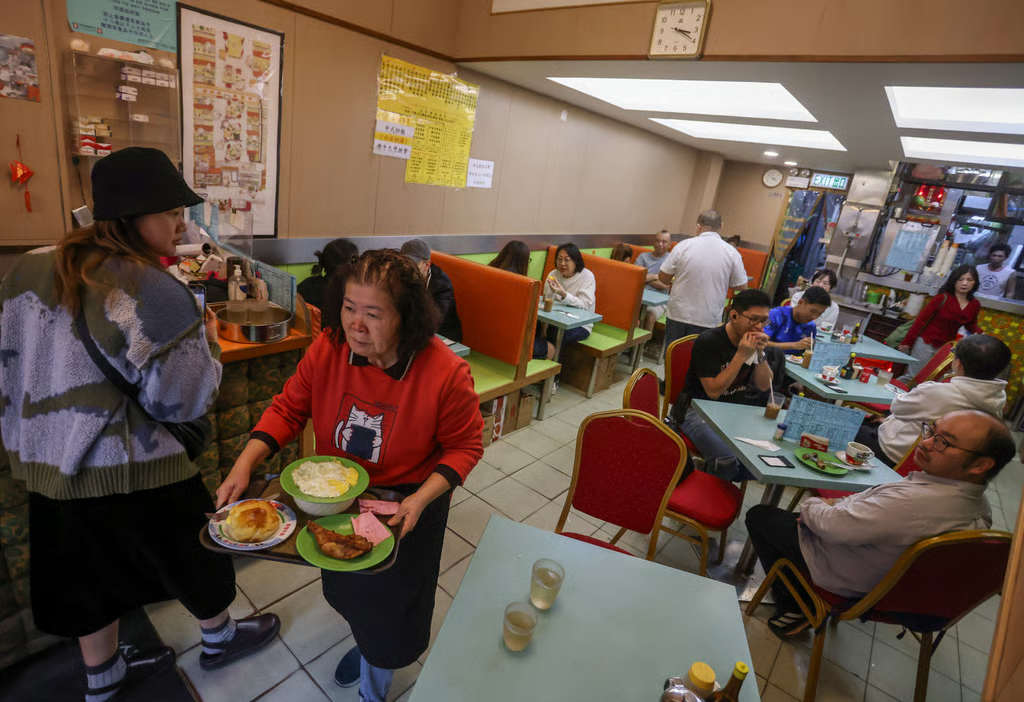
Zung then revealed that though the return was advertised as a revival of the old place, the cha chaan teng had been purchased by Tsui Wah Group, an international restaurant operator that started in Hong Kong as a local chain of cha chaan tengs. Hung Wan’s exterior was preserved, but the interior was hollowed out. Everything from the staff and menu to the decorations was completely replaced.
A customer at the new Hung Wan Cafe, Eddie Kwan, said that though he noticed the changes to the restaurant, he wasn’t aware that the store had been bought out by Tsui Wah. “It does make sense, like they have to stay afloat somehow,” he said, “but it just doesn’t have that same nostalgic feeling of having Hong Kong food at a classic cha chaan teng anymore.”

Kwan’s opinion reflects the evolving cuisine landscape in Hong Kong. According to numerous tourism websites, one of the most attractive features of Hong Kong is the kaleidoscopic food and beverage scene, ranging from extremely cheap local cuisine to high-end fine dining, and everything in between.
Kent Wong, a food blogger with over 200,000 followers on Instagram, often can be found posting reviews of Hong Kong restaurants. Known online as “Uncle K Hong Kong”, he says that it is the fusion of all the inbound cultures introduced to the city by its diverse base of immigrants that makes Hong Kong food what it is.
View this post on Instagram
“Our city is fundamentally a city of immigrants. We don’t really have any food that was native to us that is not a fusion of two different cultures and adjusted to the taste buds of Hong Kongers,” Wong said, pointing to some of the staples that are ubiquitously agreed upon to be Hong Kong food.
Hong Kong milk tea, also known as silk-stocking milk tea, evolved from traditional Chinese tea practices by incorporating milk, which was influenced by British culture during Hong Kong’s colonisation in the 19th and 20th centuries. Finally, Hong Kongers brewed tea in cotton bags like silk stockings for smoother, less bitter tea. They used evaporated milk instead of fresh milk to cut costs and make the tea silkier.
Wong passionately described the process of how this beloved drink came to be, emphasizing the multicultural history of Hong Kong with the inventiveness of Hong Kongers when it comes to their food.

The same can be said for many other iconic Hong Kong dishes. Egg tarts are a unique spin on the Portuguese pastel de nata. Curry fishballs, a blend of traditional Chaozhou with Indian curry sauce, were introduced to Hong Kong by the British. Dim sum, a wide variety of little dishes from all over China, has been adapted to the Hong Kong and Cantonese palate.

Yet, while these beloved dishes remain a symbol of local cultural identity, restaurants like Hung Wan Cafe are increasingly under threat. Across Hong Kong, family-run eateries that once defined the city’s everyday life are struggling to stay open. Rising rents, staff shortages, and a younger generation reluctant to inherit long, exhausting workdays have pushed many to the edge. Small restaurants across the city are being priced out of their own neighborhoods. Even long-standing favorites with loyal customers are closing after decades of service.
Fuk Wing Cafe in Sham Shui Po for over 30 years closed in June 2025. In Tai Koo Shing, Wah Cheong Congee & Noodle, a breakfast spot beloved by nearby office workers and residents for over 40 years, shut down in June 2025. Their closures mark not only economic loss but the fading of spaces where generations once gathered for ordinary, comforting meals.
Hong Kong’s retail vacancy rate reached 12.1 percent in mid-2025, the highest in more than four years. According to the quarterly market report of real estate consultancy Colliers Hong Kong, the number of vacant shops in Central rose by 7.3 percent in six months, from 193 in Q3 2024 to 207 in Q1 2025.
Landlords, unwilling to lower rents, let shops sit empty rather than lease them at reduced prices. For small restaurateurs, survival feels impossible. Two long-time local favourites, Fu Tung Seafood Restaurant in Sha Tin, known for its traditional Cantonese dishes, and Souper Authentic in Sheung Wan, famous for its home-style double-boiled soups, both shut their doors in mid-2025. The reason was the same: after sharp rent increases, the owners could no longer manage the rising costs and had no choice but to close.
“The next generation is unwilling to take over, rising rents have become a heavy burden, and running the business has grown increasingly difficult,” said Wong, who has been blogging about food for 4 years.
For Kwan, a lifelong Hong Kong resident who eats at a neighbourhood cha chaan teng almost every day, these closure feel deeply personal. “Each time a familiar cha chaan teng disappears into memory, Hong Kong loses not merely another restaurant but a fragment of its everyday spirit,” he said.
As local eateries dwindle and disappear, something new is taking their place.
Walk through Causeway Bay, Tsim Sha Tsui, or Mong Kok today and the change is impossible to miss. Supported by strong funding and smart timing, mainland brands are rapidly filling Hong Kong’s shopping and dining streets, reflecting deeper economic ties and shifting consumer tastes.
“The mainland economy is tightening and highly competitive, so they must find new markets and Hong Kong is the first stop,” said Wong. “With more mainland students and workers here, these brands also cater to their tastes.”

As of October 2025, 71 mainland brands were operating about 255 stores across the city, ranging from drink franchises like Heytea, Chagee and Mixue to dining chains such as Haidilao, Taier and Yuan Ji Yun Jiao.

Many of these brands have shown that they are here to stay and compete. Chagee opened its first Hong Kong store in September 2024, and just a year later opened a tenth location in the chain’s rapid expansion across Hong Kong. It is a small number compared with Starbucks, which has over 170 outlets in Hong Kong. But Chagee’s draw is not scale, it is the comfort of an affordable cup of Chinese-style milk tea and the constant stream of new flavours meant to catch local curiosity. The real question is whether these tastes can find their place in Hong Kong’s daily rituals.

“Hong Kong’s food identity has always been defined by absorption and adaptation,” Wong said. “All foreign cuisines have to adapt to Hong Kong’s character. If they survive, it is because they have evolved to suit local tastes. That is what Hong Kong flavor is.”
For decades, that flexibility defined the city’s charm. But now, some feel the flow has reversed. “It used to be Hong Kong reshaping outside flavours, now it feels like the other way around,” said Loong Ma, owner of Kam Kee Product, a Hong Kong-style hotpot restaurant that has been operating for more than 37 years.
Watching the wave of mainland brands move in, he worries that the city’s once-vibrant food scene is beginning to lose its local flavour – the taste that made Hong Kong, Hong Kong.

In recent years, the government has launched campaigns, such as “Night Vibes Hong Kong” in 2024 and “Taste Around Town” in 2023, to preserve local flavour. The festivals were aimed at both residents and tourists and promoted local businesses.
However, behind these top-down events, underlying issues remain acute. Simon Wong Ka-wo, president of the Hong Kong Federation of Restaurants and Related Trades, warned that, “without urgent support and innovation, we risk losing not just businesses, but a vital part of Hong Kong’s culinary heritage.”
Restaurants can apply for loans under the SME Financing Guarantee Scheme as well as funding grants such as Upgrading and Domestic Sales (BUD Fund) and the SME Export Marketing Fund (EMF), but ongoing economic difficulties have blunted the potential effects. Algernon Yau Ying-wah, Secretary for Commerce and Economic Development of Hong Kong, noted that loans guarantee cash flow but don’t solve issues like high rents or the gap in digital skills. According to Yau, Hong Kong lags in digitization, especially in F&B, with many traditional brands lacking strong online marketing or channels like livestreaming, which are common on the mainland.
However, history has shown that foreign brands are not necessarily a negative presence. International mainstays like McDonald’s entered the Hong Kong market during the 1970s. To this day, Mak Gei (M記) attracts one million customers every day, and remains a staple for anybody looking for cheap, quick bites. It has even created a niche alongside Starbucks as a hot-spot for private tutoring sessions, adapting to the needs of Hong Kongers.
Nevertheless, regardless of local Hong Kongers’ attitudes towards the influx of mainland food brands, the new trend is inevitable. “After all, with so many local places closing down, it’s no surprise that mainland brands see an opportunity to step in,” said Zung.

Wong, however, believes that the crisis offers opportunities for innovative dining concepts and local hybrid innovations.
“The idea of what counts as ‘local food’ in Hong Kong seems to be changing all over again, with people rethinking what that really means nowadays,” he said. “As long as Hong Kongers persist in innovation, Hong Kong food will endure.”